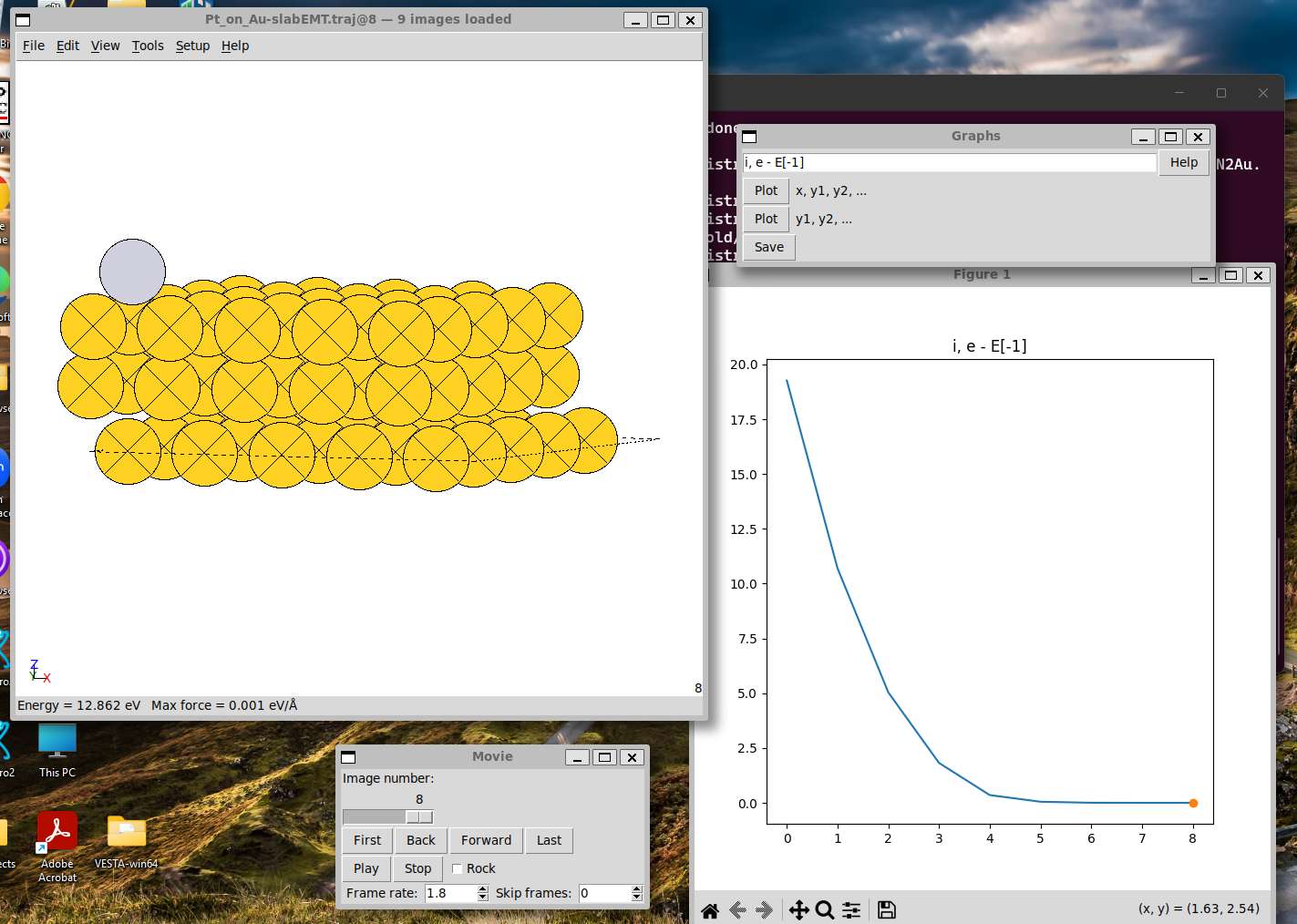
The gold surface is used as a detector cover in the preparation of superheavy elements in one-atom-at-a-time experiments, a complicated process also conducted here in the Flerov Laboratory of Nuclear Reactions at JINR in Dubna. There, synthesized atoms and their possibly formed molecules adsorb onto the gold surface, and experimentalists estimate their adsorption enthalpy. To shed more light on the process at an atomic level, computationally feasible, simple atomistic modeling with the Atomic Simulation Environment tool (ASE, \url{https://ase-lib.org/} ) is utilized to predict adsorption energies and even adsorption enthalpies of atoms. This open-source methodology is based on interatomic potentials (IP), spanning from the simplest (like Lennard-Jones) to sophisticated machine-learned ones (ML-IP). This project, lasting for 6 weeks, is co-supervised by Dr. Dipayan Sen from BLTP JINR.
Tasks
• Setting up Linux environment on the participant’s personal computer
• Installing and testing ASE on the participant’s personal computer
• Download and run the ASE demonstration programs from the open repository, https://github.com/miroi/open-collection/tree/master/theoretical_chemistry/projects/adsorptions_with_ase
• With the help of the supervisor, modify the provided programs
• With the adapted programs, conduct adsorption calculations
• Collect and process the computed results; write the report in Overleaf
Preliminary schedule by topics/tasks
• Week 1: Install and test ASE on your personal computer
• Week 2: With the supervisor’s help, modify programs from theopen repository, https://github.com/miroi/open-collection/tree/master/theoretical_chemistry/projects/adsorptions_with_ase
• Week 3: Modify and run the program for the adsorption of various atoms
• Week 4: Collect results, such as computed energies, final geometries, pictures of converged structures, etc.
• Week 5: Start writing the report in Overleaf
• Week 6: Finalize the report with the supervisor’s help
Required skills
• Install and test ASE on your personal computer
• Download and run the demonstration software from the open repository
• With the help of the supervisor, modify the provided software
• With the modified software, run more calculations
Acquired skills and experience
• Mastering Linux administration on one’s personal computer
• Mastering the installation and testing of ASE and related packages
• Improving programming skills in Python
• Learning the basics of atomistic modeling in ASE
• Learning to set up adsorption simulations in ASE for computing adsorption energies
• Mastering Overleaf for report writing
Recommended literature
• Atomic Simulation Environment webpage, https://ase-lib.org, with tutorials and references therein
• The Web Python Tutorial, https://docs.python.org/3/tutorial/index.html
• Alfred Clark : The theory of adsorption and catalysis (Physical chemistry,a series of monographs) 0th Edition, Academic Press, 1970, 418 pages,
ISBN 978-0121754501
• Yu. K. Tovbin : The Molecular Theory of Adsorption in Porous Solids, CRC Press, 2017, 780 pages, ISBN 9781351649711